
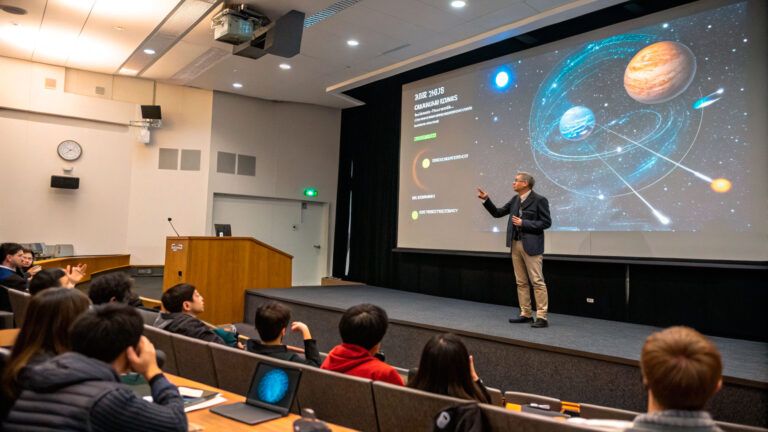
- All Andalusian public universities, together with national and international academic centres, will participate in the second edition of the meeting to be held from 14 to 17 April in Seville.
- New Space & Solutions 2026 reinforces its commitment to connecting universities, industry and institutions, promoting training and talent as fundamental pillars for the growth of the space sector in Europe.
Seville will once again be on the map for space innovation with the second edition of New Space & Solutions – “Where we tell you what New Space does for us“. The event will bring together companies, institutions, research centres and universities to analyse the challenges and opportunities of the new space economy and New Space, with a special focus on talent training and the role of universities in the development of the sector. The meeting will be held in a hybrid format from 14 to 17 April 2026, with two face-to-face days at the Cartuja Auditorium – managed by Yventu – located in Seville TechPark, on Tuesday 14 and Wednesday 15 April, and another two virtual days on Thursday 16 and Friday 17.
In this context, one of the days of the meeting will be dedicated to universities and the generation of space talent, with the participation of academic representatives from different national and international centres, as well as from all the public universities in Andalusia, who will attend under the umbrella of the Regional Ministry of Universities, Research and Innovation of the Regional Government of Andalusia.
The aim of this session will be to highlight the role of universities as drivers of research, technology transfer and the training of highly qualified professionals, which are essential in responding to the growing demand for talent in the space sector.
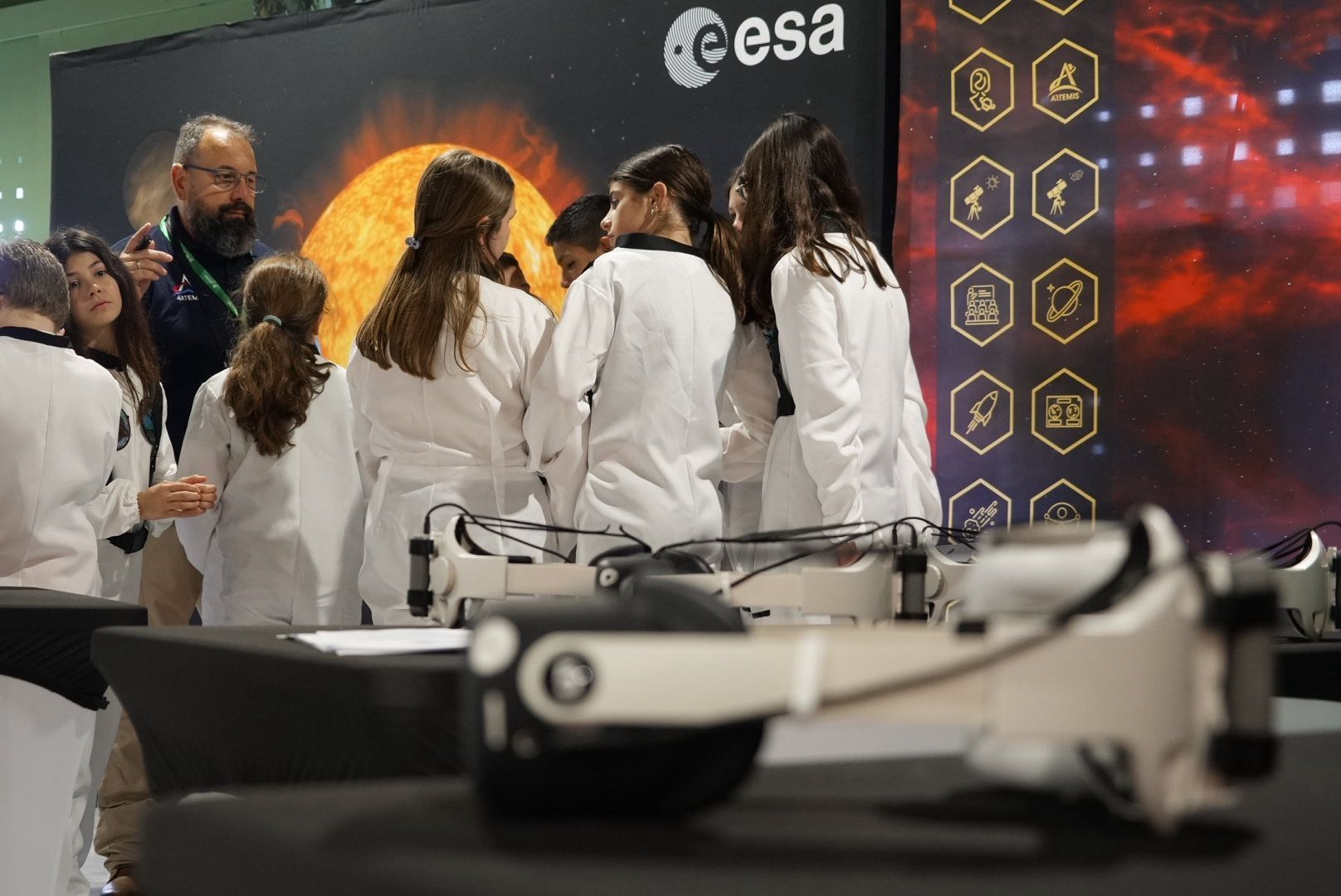
Pablo de Olavide University and the Polytechnic University of Valencia take centre stage
Among the participating universities, the Pablo de Olavide University (UPO) stands out, represented by its rector, Francisco Oliva Blázquez, whose speech will highlight the institution’s commitment to the development of scientific knowledge and collaboration with the technological and business ecosystem.
The Polytechnic University of Valencia (UPV) will also participate with Pedro Martí Gómez-Aldaraví, university professor and academic director of the Master’s Degree in Space Engineering, who will present the role of the UPV as a strategic hub in the European aerospace landscape.
During his speech, he will address how the UPV integrates cutting-edge research and specialised training through its space engineering programme, highlighting its capabilities in mission design, propulsion systems, nanosatellite development and communication systems. He will also explain how these lines of R&D&I feed into the training of a new generation of highly qualified engineers and facilitate technology transfer to industry.
The Andalusian university ecosystem, present at New Space & Solutions
The conference will also feature representatives from Andalusian public universities, who will showcase their main lines of research and projects related to aerospace and technology.
The University of Malaga will play a prominent role with the participation of Pedro Merino, director of the Institute of Technology and Software Engineering at the University of Malaga, who will present the opportunities for 5G satellite testing on the Victoria Network. During his presentation, he will showcase an extension of this research infrastructure at the University of Malaga that allows the use of real equipment in 5G satellite connections, both in transparent and regenerative modes and in LEO and GEO orbits, opening up new possibilities for experimentation and the development of advanced space connectivity solutions.
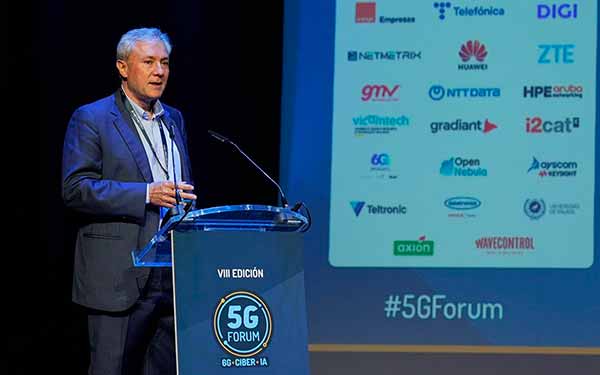
Pedro Merino, director of the Institute of Technology and Software Engineering at the University of Malaga, during the eighth edition of the 5G Forum, organised by Medina Media Events, held in May 2025.
The University of Seville will feature the prominent participation of Aníbal Ollero, director of the GRVC Robotics Lab at AICIA–University of Seville, scientific director of the Centre for Advanced Aerospace Technologies (CATEC), and member of the Royal Academy of Engineering, as well as IEEE Fellow and co-chair of the IEEE Technical Committee on Aerial Robotics and Unmanned Aerial Vehicles. During his presentation, he will outline his group’s research activities in the field of space, with a special focus on the European Stratolaser project, funded by the Horizon Europe programme, in which they coordinate a European consortium focused on developing innovative solutions to tackle the growing problem of space debris. The University of Seville will also be represented by Guillermo Pacheco, a professor at the institution, who will offer an overview of training and talent development in the field of space at the University of Seville, highlighting the academic programmes and projects that connect university research with the needs of industry.
The University of Huelva will be represented by Álvaro Gómez Villegas, technical manager of the El Arenosillo Experimentation Centre (CEDEA) and the Medium and Large Unmanned Aerial Systems Test Centre (CEUS). During his presentation, he will review the historical and current relevance of El Arenosillo, an international rocket launch base since the 1960s, where more than 500 launches have been carried out and which today continues to be a key centre for the development and testing of experimental rockets, drones and suborbital platforms.
Also from the University of Malaga will be Sergio Fortes, a researcher from the Mobilenet: Mobile & Aerospace Networks Lab group, who will present important initiatives by the University of Malaga in the space sector: research into satellite communications and AI developed at the Malaga Satellite Centre, a co-innovation centre run by the University of Malaga with Vodafone and AST SpaceMobile; the Málaga Space Team, a team of students developing a cubesat; and the spin-off Albor Space, focused on innovative low-cost satellite communications solutions based on software-defined radio.
For its part, the University of Granada will participate with Francisco Barranco Expósito, university professor, who will present the PROACTIF project, focused on the development of autonomous vehicles equipped with artificial intelligence for the protection of critical infrastructure. The research combines computer vision and advanced location systems to detect risks in environments such as ports, airports, or electrical substations, even in situations where GPS signals are not available.
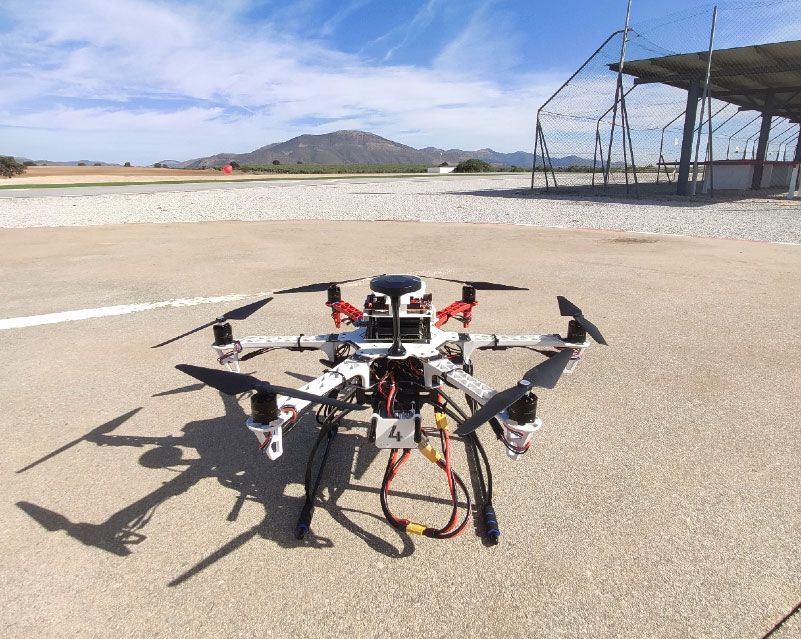
Image of an AI-based drone for the protection of critical infrastructure belonging to the PROACTIF project (Facebook University of Granada).
The University of Almería will be represented by Professor Fernando José Aguilar Torres, who will present the SOTER project, an R&D&I initiative that develops an innovative methodology for the automated inspection of road surfaces and safety elements using very high-resolution satellite images and artificial intelligence techniques, with the aim of improving road safety and optimising infrastructure maintenance work.
From the University of Cádiz, Sara González de la Torre Muñoz, professor in the Department of Psychology, will address the role of the human factor in space missions with the presentation ‘Humans, machines and space missions: training and validation in analogues‘. Her presentation will focus on the study of human performance, team dynamics and human-robot interaction in extreme environments, using space analogues to validate training and decision-making protocols in conditions of isolation and high operational load.
The University of Jaén will be represented by María del Carmen Muñoz, professor of Public International Law and director of the AstroÁndalus University Chair in Aerospace and Astronomical Studies, who will address the legal and strategic aspects related to the development of the space sector.
The University of Córdoba will also participate with Francisco Javier Mesas Carrascosa, professor in the Department of Graphic Engineering and Geomatics, who will talk about Agriculture 4.0 and present the institution’s lines of work in areas related to geomatics engineering and technologies applied to the observation and analysis of the territory.
Similarly, New Space & Solutions 2026 will feature the participation of Loyola University, with Álvaro Parody, professor and coordinator of the Aerospace Engineering Degree at Loyola University’s Higher Technical School of Engineering; and CEU Fernando III University, represented by José Antonio Domínguez, academic secretary of the Higher Polytechnic School.

International collaboration
In addition to the Spanish university ecosystem, the meeting will also feature the participation of the University of Coimbra (Portugal), which will provide an international perspective on the training of specialised talent and technology transfer processes to the space industry.
With this broad academic representation, New Space & Solutions 2026 reinforces its commitment to connecting universities, industry and institutions, promoting training and talent as fundamental pillars for the growth of the space sector in Europe.
All New Space & Solutions conferences will be available for viewing on demand through The Observatory, Medina Media Events’ digital platform, where each conference will be available 24 hours a day, 365 days a year, free of charge.
The second edition of New Space & Solutions is organised by Medina Media Events and supported by Seville City Council; the Regional Ministry of Universities, Research and Innovation of the Regional Government of Andalusia; the Regional Ministry of Sustainability and the Environment; the Regional Ministry of Industry, Energy and Mines, Canary Islands Aerospace Strategy (Government of the Canary Islands), Netmetrix, Sceye, Rohde & Schwarz, PCB Piezotronics, Pablo de Olavide University, CATEC, ISDEFE, UARX, HALO Space, Kistler, Eurecat, DEKRA, Open Cosmos, Solar MEMS, B2Space, Quside, Systratec, Keplerkoord, Augusta Abogados, Bufete Mas y Calvet, LORTEK, Flux, Metadev, NDK, Alfalite, University of Malaga and the Polytechnic University of Valencia, among others.